
How to Choose the Right Air Duct Cleaning Company in South Gate
Choosing the right air duct cleaning company in South Gate comes down to three questions: what vacuum capture method they use, what mechanical agitation equipment is on the truck, and whether they inspect your system before quoting a price. Get clear answers on those three and you’ve eliminated most of the operators who shouldn’t be in your home at all. If you’d rather skip the vetting and talk to someone who can answer all three in detail, call (855) 925-0879.
The Three Questions That Actually Matter
Most homeowners start their search by comparing star ratings and price. That’s a trap. The industry has operators who rent a truck-mount vacuum on Friday, pass out flyers on Saturday, and disappear by Monday. Star ratings won’t catch them. Equipment questions will.
Here’s the vetting framework we recommend to every South Gate homeowner before booking anything:
- Question one: what vacuum capture method do you use? This separates source removal cleaning from contact vacuum cleaning. Contact vacuuming means someone shoves a vacuum hose up a vent and sucks what’s near the opening. Source removal means negative pressure is established across the entire duct run, agitating debris off the walls and pulling it out of the system entirely. One is surface cleaning. The other is the actual job.
- Question two: what mechanical agitation equipment do you use, and can I see the model number? A brush on the end of a drill won’t scour a 30-foot duct run. Professional systems like Rotobrush rotary brush-and-vacuum systems physically scrub the interior walls of the duct while simultaneously extracting the loosened debris. Anything less leaves material behind.
- Question three: will you inspect the system before quoting? Any company quoting a flat price without asking about your square footage, register count, or whether you have flex duct versus sheet metal is guessing. Guessing is how you get a bait price that balloons once the technician is on site.
We’ve run these questions ourselves against the equipment we deploy across South Gate. The answers are Rotobrush for agitation, Nikro HEPA-rated vacuum systems for capture, and Abatement Technologies negative-air equipment for containment. Professional-grade equipment, residential pricing. That’s the gap between a specialist and a generalist.
Negative Pressure vs. Push-Pull: Why the Vacuum Method Decides the Outcome
The most important distinction in air duct cleaning is also the least discussed in marketing materials: the pressure relationship between the duct interior and the room it sits in. Get this wrong and you’re not cleaning. You’re redistributing.
A push-pull setup uses a blower to shove air into the duct, forcing debris toward a vacuum opening. It sounds aggressive. It actually just scatters fine particulate into the living space through any gap, register, or access point along the way. You’ll find the evidence on your furniture three days later.
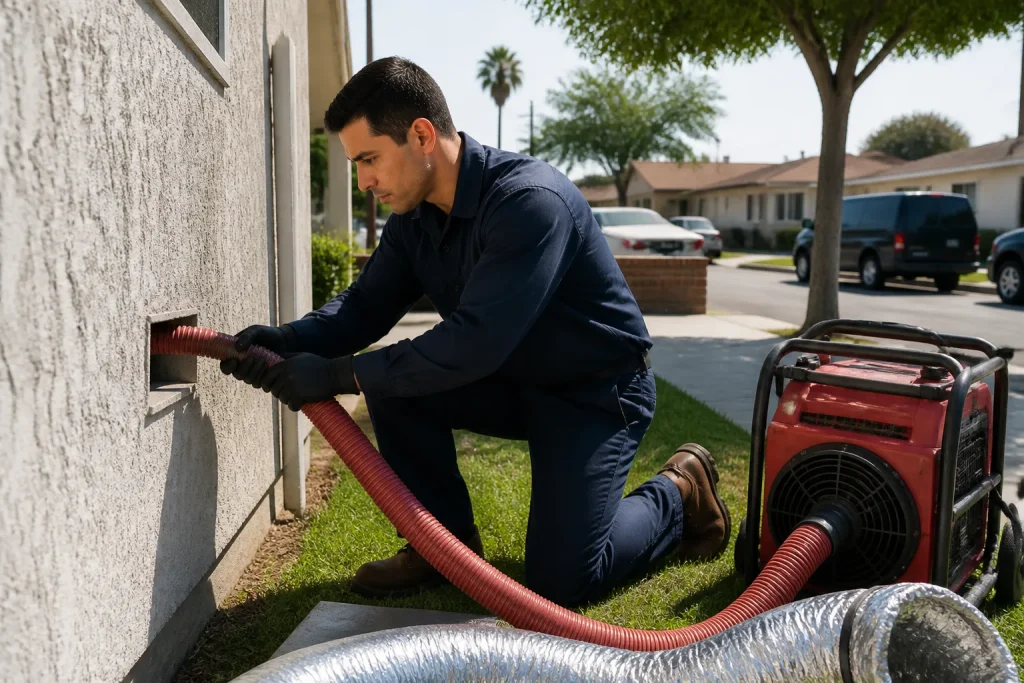
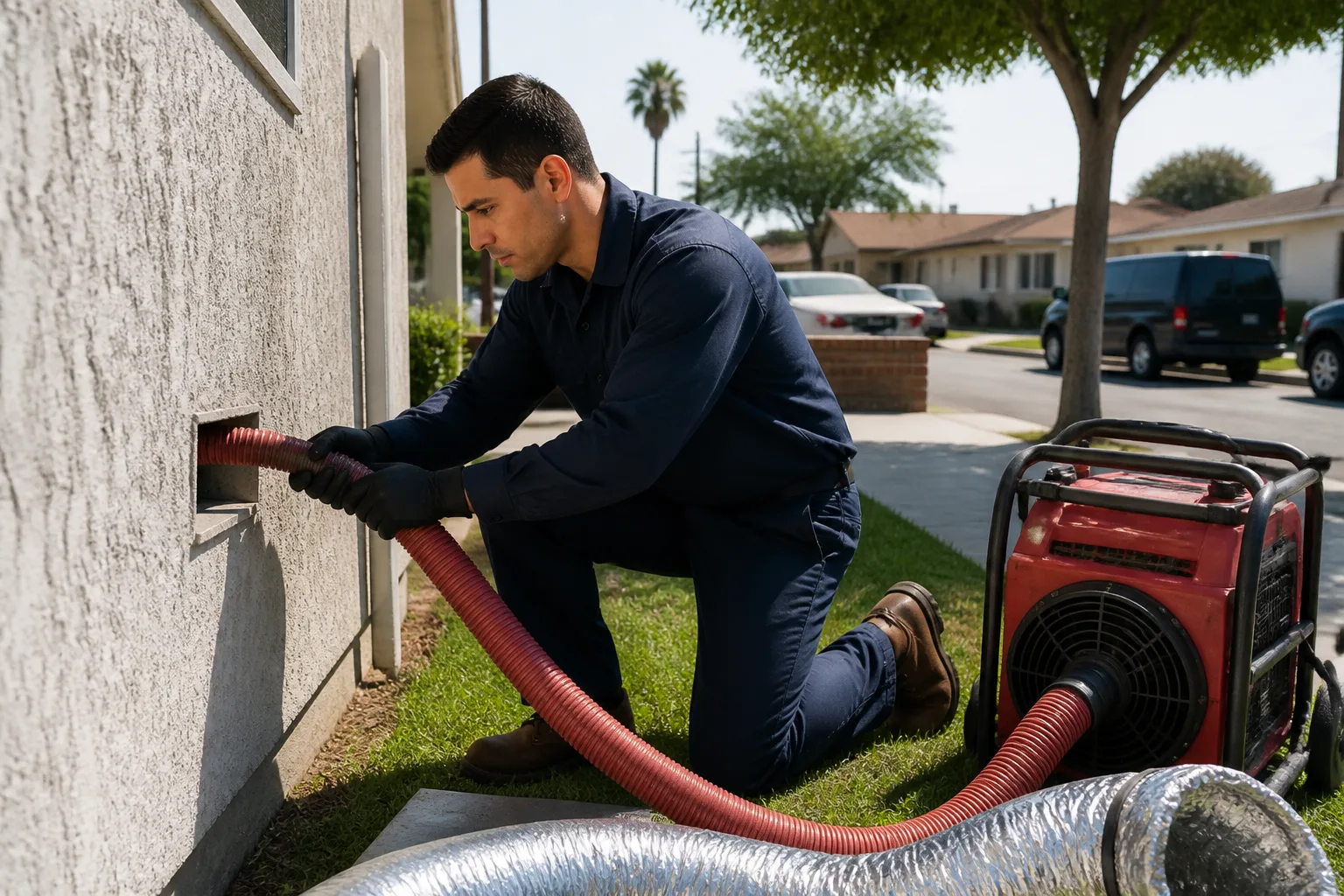
Negative pressure works the other direction. The vacuum establishes suction across the entire duct run, so the duct interior is at lower pressure than the room around it. Loosened debris gets pulled toward the capture system, not pushed out through gaps. For that approach to matter, though, the vacuum has to sustain enough airflow to move particulates from the full length of the run. This is why CFM ratings matter more than horsepower stickers. Many budget services run shop-vac-style units that spike high on paper and fall flat under real-world resistance. A sustained CFM rating with a true HEPA filter, on the other hand, holds suction through the entire cleaning cycle instead of losing it as the filter loads.
Our air duct cleaning approach uses Nikro HEPA-rated vacuum equipment and Abatement Technologies negative-air systems borrowed from commercial restoration practice. Captured, not recirculated. When a technician working in South Gate can explain that distinction in one sentence, you’re talking to someone who does this for a living.
Agitation Equipment: The Brand Names You Should Hear
Vacuum capture alone won’t remove debris that has been pressed onto duct walls by years of airflow. Humid air bakes dust into corners. Grease from kitchens works its way into the return runs. The solution is mechanical agitation, and the equipment quality varies widely across providers.
Rotobrush systems are what you want to hear referenced. A rotary brush physically scrubs the interior surface of the duct, dislodging the compressed material, while vacuum extraction pulls it out in the same pass. It’s not a static hose – it’s a brush-and-vacuum process purpose-built for duct interiors. It’s also not what the typical flyer company runs, because the equipment costs real money and requires people trained to use it.
Ask any contractor to name the model of their agitation and vacuum equipment. If the answer is vague or sounds like they haven’t thought about it, that’s the answer. If they name Nikro, Rotobrush, or Abatement Technologies and can tell you why they chose each, you’re in different territory. Equipment you can verify by name beats superlatives every time. We run Rotobrush rotary systems for exactly this reason: the duct walls get scrubbed in South Gate homes, not just vacuumed down the center.
Why Some South Gate Quotes Are Suspiciously Low
If you get a quote for a whole-house duct cleaning under $150, something doesn’t add up. The math doesn’t work unless someone is cutting corners, and the corners they cut are the ones that keep your home from getting filled with debris.
Here’s what a low quote usually buys:
- A residential shop vacuum instead of a true negative-air machine. Shop vacs are loud, so the job sounds thorough. The flow rate drops as the filter loads, and the capture isn’t HEPA. The fine stuff just goes airborne in your living room.
- No containment. None of the equipment needed to isolate the work area or manage air exchange during cleaning. Without it, the dislodged particulate is in every room with a return register, whether pulled from deep in the system or not.
- A time box, not a procedure. A 45-minute job for a 2,000-square-foot house means someone skipped something. Proper cleaning of supply and return runs, the plenum, and the filter housing takes longer than that.
- No pre-inspection. When someone quotes a number before looking at the system, you’re not getting an estimate. You’re getting a fishing line.
Honest pricing reflects scope: number of registers, system size, access difficulty, duct material. Our prices are set per job by written estimate, agreed before work starts. No per-vent pricing games. No surprise invoice after the van is in the driveway. Call (855) 925-0879 for a free estimate and we’ll walk you through what we’d actually do in your home.
What a Legitimate Post-Service Report Includes
The absence of documentation is itself a data point. A company that cleans your ducts and hands you a receipt with no evidence of what they did is asking you to trust an invisible service. Legitimate providers give you a window into the system you can’t easily open yourself.
A proper post-service report should include:
- Before-and-after photos at the plenum. The plenum is where the main trunk meets the air handler, and it’s where accumulation is most visible. Photos from that location, before and after, are the single most useful piece of verification you can receive.
- Register count serviced. If your home has 14 registers, the report should state that 14 registers were serviced. If the number looks wrong, ask about it.
- Filter condition notation. The technician should note what condition your filter was in when work started, and whether it needed replacement. A filter fully loaded with debris tells you something about how the system has been maintained.
- Access point locations. Where the technician entered the ductwork matters for future service. It should be recorded.
If a provider can’t or won’t provide this documentation, treat that as a refusal to verify their own work. In our experience across South Gate properties, homeowners who receive before-and-after documentation are far more confident in what they paid for. That’s the standard we hold ourselves to.
What happens when you call
- 1
A real person answersNo phone trees – you reach a local pro.
- 2
You get an upfront price rangeHonest numbers before anyone is dispatched.
- 3
A background-checked tech heads outLicensed & insured, dispatched right away.
- 4
You approve before work beginsNothing starts until you say go.
South Gate Specifics: Red Flags After a Santa Ana Event
South Gate sits where inland heat and dry seasonal winds shape how much dust actually finds its way into homes. The air gets dry, the dust gets fine, and it finds every penetration in a home’s envelope. That means HVAC systems here collect a specific kind of particulate load: light, fine, and deeply embedded in the return runs.
It also means certain seasons produce fly-by-night solicitation. After a strong wind event, some operators go door to door claiming the dust “in your vents” is a fire hazard and offering a same-day special. Be skeptical of anyone soliciting a same-day whole-house duct cleaning without inspecting the home first. It is a sales tactic, not an assessment.
A reputable South Gate provider works by inspection, written estimate, and scheduled work. The home’s actual condition, duct material, and system layout determine scope. None of that can be assessed from a doorstep.
One thing specific to our market worth knowing: ductwork in older South Gate housing stock often dates from before current energy standards, and many systems leak at the plenum connections or in the branch runs. If airflow in one bedroom is noticeably weaker than the rest of the house, cleaning may not be the answer. We repair ducts, not just clean them, and our air duct cleaning scope frequently turns up connection failures that a cleaning-only provider would simply not mention. It’s the difference between treating symptom and cause.
Dryer Vents: The Forgotten Fire Hazard
Your dryer vent is a fire risk your HVAC company won’t mention. Not because they’re hiding anything, but because most HVAC providers don’t think in that direction. They’re trained to sell system replacement. The vent behind the dryer is someone else’s problem.
It’s also a recognized residential fire hazard, documented by national fire safety organizations. Lint accumulation restricts airflow, raises exhaust temperatures, and creates the conditions for ignition. The fact that it’s out of sight means it falls out of mind until a problem appears.
Professional dryer vent cleaning addresses the restriction before heat builds to dangerous levels. It’s not an add-on service when we do it – it’s a safety scope item with the same documentation standard as the air duct work. If your dryer runs hot to the touch, smells burning, or takes longer than one cycle to dry a normal load, schedule the service now. If you’d rather not wait for a symptom, give us a call at (855) 925-0879. We answer 24/7. Fast dispatch from 7am to 7pm.
Related Services in South Gate
Ductwork doesn’t operate in isolation. It connects to the air handler, the filtration, and the home’s pressure balance. That’s why we work with Honeywell and Aprilaire air-quality systems: duct performance means nothing if the whole-home filtration isn’t functioning against the actual particulate load. Our technicians are familiar with how duct leakage undermines the work of a whole-house HEPA filter, and how humidity control systems like Aprilaire interact with duct performance. It’s a full-system view, not a duct-tunnel view.
When a duct problem is actually a breach, the fix is air duct cleaning plus repair. When a dryer vent is restricted, the fix is its own scope of work. When the system is clean and sound, the goal is keeping it that way. All three services live under one provider at Duct Cleaning South Gate.
If you’re in South Gate and need help determining whether your system needs cleaning, repair, or both, call (855) 925-0879 for a free estimate. No obligation. Real answers about your actual system.
The Bottom Line
Choosing the right air duct cleaning company in South Gate is not a question of star ratings. It’s a question of equipment and protocol. Ask about vacuum capture method, agitation equipment model, and whether they inspect before quoting. If the answers are vague, keep looking. If the answers name Rotobrush, Nikro, or Abatement Technologies and the provider offers a documented report with before-and-after photos at the plenum, you’ve found a specialist.
Red flags are consistent: suspiciously low quotes, no inspection before quote, and no documentation after the work. Legitimate providers welcome your questions and can explain their process in detail. If you’re in South Gate and need help, Duct Cleaning South Gate offers free estimates at (855) 925-0879. We answer 24/7. Fast dispatch from 7am to 7pm, Sunday through Friday.
Frequently Asked Questions
A legitimate air duct cleaning company can answer three technical questions without hesitation: what vacuum capture method they use, what mechanical agitation equipment is on the truck, and whether they inspect before quoting. They name the equipment brands and explain why those brands matter. They provide post-service documentation including before-and-after photos. If an operator is vague about any of this, they’re not a specialist.
Pricing depends on system size, register count, duct material, and access difficulty. A whole-house cleaning priced under $150 is a red flag, because it doesn’t cover the cost of running legitimate negative-air equipment with HEPA capture. Honest providers quote per job by written estimate after inspecting the system. Call (855) 925-0879 for a free estimate based on your actual system.
Fine particulate does accumulate in ducts during South Gate’s dry, windy periods, but that’s not an emergency. Allow a legitimate provider time to inspect, quote, and schedule the work. Be wary of door-to-door solicitation offering same-day specials after a wind event – that’s a sales pressure tactic, not an assessment of your home’s condition.
Air duct cleaning addresses the supply and return runs of your HVAC system. Dryer vent cleaning addresses the exhaust duct from your dryer, which is a separate pathway and carries a distinct fire-safety priority. Lint accumulation in dryer vents is a recognized residential fire hazard. A provider may offer both services, but they require different tooling and should be scoped and documented separately.
Written by the team at Duct Cleaning South Gate, serving South Gate since 2013.
Need Air Duct Cleaning Help?
Call Duct Cleaning South Gate - licensed & insured, here with fast help in South Gate.
(855) 925-0879